
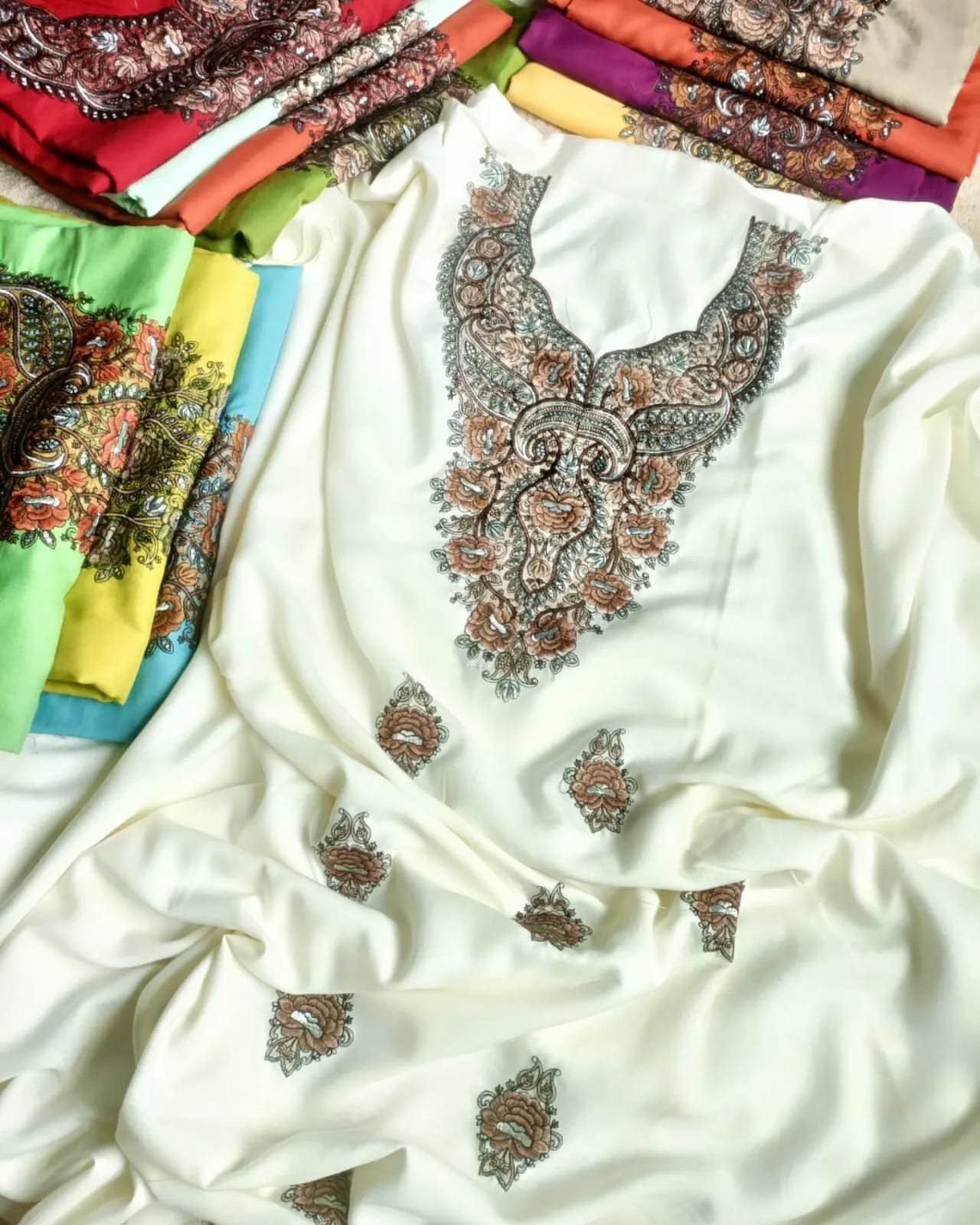
The Threads of Time: A Comprehensive History of Sozni Embroidery
In the high-altitude valleys of Kashmir, where winters stretch for months and isolate communities from the outside world, textile artistry evolved not merely as a commercial enterprise, but as a profound spiritual and cultural expression. Among the intricate needlecraft traditions of the region, Sozni (or Suzni) stands as the pinnacle of micro-detailing, patience, and refined elegance.
Often executed on fine pashmina shawls, silk garments, and lightweight woolens, Sozni is widely regarded as one of the most sophisticated needle-embroidery techniques known to human history.
1. Origins and Persian Roots
The history of Kashmiri textile embellishment is deeply intertwined with the geopolitical movements of Central Asia and the Mughal Empire. While shawl-weaving had flourished in Kashmir since ancient times (with early references dating back to the reign of King Zain-ul-Abidin in the 15th century), embroidery as a primary surface design technique underwent a revolution during the Mughal era in the 16th and 17th centuries.
-
The Silk Route Influence: Artisans and master craftsmen migrated between Persia, Central Asia, and the courts of Delhi and Srinagar. Persian motifs—such as the Badam (paisley or mango motif), blossoming floral sprays (Buteh), and intricate trellis work (Zal)—were introduced to Kashmiri weavers and needleworkers.
-
The Evolution from Loom to Needle: Originally, patterned shawls were produced exclusively on the loom using the Tapestry or Kani weaving technique, where multi-colored wooden spools (Tujlis) created complex motifs row by row. However, as demand surged and royal patrons desired even finer, more painterly shading and curves that looms struggled to replicate, master craftsmen turned to the needle. Thus, Sozni embroidery was born.
2. The Anatomy of Sozni: Technique and Mastery
Sozni is essentially a form of fine needlework executed using extremely delicate embroidery needles (Sozni-dooz). What distinguishes Sozni from standard embroidery is its micro-scale precision and the complexity of its stitch work.
A. The Stitches
-
Stem Stitch and Satin Stitch: The foundation of Sozni relies on micro stem stitches to outline complex floral motifs and satin stitches to fill them in. However, the stitches are so minuscule that they often blend into the fabric, making the embroidery look like a seamless painting rather than raised thread.
-
Double-Sided Perfection (Dorukha): One of the greatest achievements of master Sozni artisans is the Dorukha technique. In a true Dorukha piece, the embroidery is executed so cleanly that both the front and the reverse side of the fabric look identical. There are no loose threads, knots, or messy overlaps on the back. This requires extraordinary bilateral control and years of specialized training.
B. The Palette and Motifs
Traditional Sozni palettes draw inspiration from the natural flora of the Kashmir Valley—often called Paradise on Earth.
-
Motifs: You will find stylized lotuses, irises, chinar leaves, weeping willows, and curling almond paisleys.
-
Shading (Talim and Color Gradation): Master artisans use silk or fine wool threads in subtle tonal variations. By blending shades of madder red, indigo blue, saffron yellow, and forest green, they create a three-dimensional, painterly depth that mimics natural light falling on flower petals.
3. The Socio-Economic Fabric: A Family Legacy
Historically, Sozni embroidery was, and largely remains, a cottage industry deeply rooted in family units across Srinagar and rural Kashmiri neighborhoods.
-
The Division of Labor: Creating a heavily embroidered Sozni Pashmina shawl is a collaborative masterpiece. It begins with the Naqash (master designer), who stamps intricate wooden blocks onto the fabric to outline the pattern. Next, the Kashgar or embroiderer takes over. Entire families often work through the winter months around a central heating basket (Kangri), stitching intricate borders and pallus.
-
Time Investment: A simple Sozni-embroidered stole might take a few weeks to complete. However, a masterclass bridal Jamawar shawl—fully covered in dense Sozni needlework (Jaam pattern)—can require one to three years of uninterrupted daily labor by master artisans.
4. Preservation and Modern Relevancy
As machine embroidery and fast fashion flooded global markets in the late 20th century, traditional Sozni artisans faced severe economic pressures. Imitation chain-stitch and automated machine copying threatened to dilute the authentic craft.
However, the resurgence of direct-to-consumer (D2C) artisan platforms and a global appreciation for slow, sustainable fashion have breathed new life into Sozni. Today, contemporary designers partner directly with Kashmiri master embroiderers to apply Sozni work not just to traditional winter shawls, but to modern lightweight cotton-silk co-ord sets, contemporary capes, and bridal fusion wear.
The needle of the Sozni artisan continues to bridge centuries, proving that human patience and artistic dedication can create enduring beauty that transcends fleeting fashion trends.