
The Definitive Guide to Authentic Kashmiri Pashmina: How to Verify Real Cashmere from Counterfeits
The word Pashmina has become one of the most misused terms in the global textile industry. Walk into any high street fashion retailer or browse through discount e-commerce platforms, and you will find hundreds of synthetic blend scarves, acrylic wraps, and fine-wool stoles labeled as “Pashmina.”
For the discerning consumer, investing in a genuine piece of Kashmiri Pashmina is not merely a purchase—it is the acquisition of a centuries-old heritage, a sustainable art form, and a masterpiece of manual labor. True Pashmina is woven from the ultra-fine undercoat fiber of the Capra hircus goat, indigenous to the freezing altitudes of the Himalayan range.
If you are purchasing fine heritage pieces, understanding the exact science and tactile markers of authenticity is essential. Here is the comprehensive guide on how to verify authentic Pashmina.
1. Understanding the Source: The High-Altitude Origin
To understand authenticity, you must understand the raw material. The fiber known globally as cashmere—and locally in Kashmir as Pashm—is harvested not from ordinary sheep, but from the nomadic Changthangi goats (or closely related high-altitude caprine species) that roam the Changthang plateau at elevations exceeding 14,000 feet.
During the biting winter months, when temperatures plummet to minus forty degrees Celsius, these goats grow a luxurious, protective double coat. The outer coat consists of coarse, long guard hair, while the undercoat is an astonishingly soft, dense, and insulating fleece.
-
The Micron Measurement: Real Pashmina fibers measure between 12 to 15 microns in diameter. For comparison, a human hair is roughly 75 microns thick. This microscopic fineness is what gives authentic Pashmina its legendary weightless warmth and buttery drape.
-
The Harvesting Process: Genuine Pashmina is never sheared off the animal like sheep’s wool. Instead, during the spring molt, nomadic herders gently comb the underbelly and neck of the goats by hand. The yield per goat is minuscule—rarely exceeding 150 to 200 grams of raw fiber per year. This scarcity dictates why authentic, hand-spun, hand-woven Pashmina commands a premium price.
2. Tactile and Visual Inspection Tests
When holding a genuine Pashmina stole or shawl, your senses are your first line of defense against counterfeits.
A. The Feel: Softness vs. Slickness
-
Authentic: Raw, unwashed, or hand-spun Pashmina has a slightly matte texture initially. When you rub the fabric between your fingers, it feels wonderfully soft, warm, and rich, but it should not feel excessively slick, slippery, or plastic-like.
-
Fake (Viscose/Acrylic): Counterfeits made from artificial rayon or synthetic blends often feel artificially silky, slippery, and cool to the touch. Real Pashmina adapts rapidly to body temperature, warming up almost instantly against your skin.
B. The Weaver’s Flaws (The Human Touch)
-
Authentic: Look closely at the weave under natural light or a magnifying glass. Authentic hand-woven Pashmina (especially traditional diamond weaves like Chashm-e-Bulbul) will reveal subtle irregularities. Because the yarn is hand-spun on a traditional wooden spinning wheel (Yarak) and woven on a handloom (Vurvun), no two centimeters are identical. You may spot micro-variations in the yarn thickness or minuscule spacing differences. These are badges of honor.
-
Fake: Factory-milled acrylic and power-loom cashmere are mechanically perfect. The weave is uniform, dense, and completely machine-calibrated without a single human imperfection.
C. The Fringe Test
-
Authentic: On traditional Kashmiri shawls, the fringes are rarely knotted in rigid, uniform industrial loops. Instead, they are often left as natural extensions of the warp threads, sometimes individually twisted by hand.
3. Scientific and Practical Verification Methods
If visual and tactile checks leave room for doubt, several physical and technical tests can verify the integrity of the fiber.
A. The Burn Test (Destructive, but Definitively Accurate)
If you own a small remnant or a fringe thread (or are willing to test an inconspicuous edge):
-
Real Pashmina (Animal Protein Fiber): When ignited with a flame, real Pashmina burns slowly with a smell resembling burning hair or feathers. It forms a dark, brittle, easily crushable ash rather than a hard plastic bead.
-
Fake (Synthetic/Polyester/Viscose): Synthetic fibers melt rapidly when exposed to flame, drip hot liquid, smell sharply of burning plastic, and cool into a hard, rigid plastic bead.
B. The Pilling Indicator
Real Pashmina, due to its exceptionally fine staple length and lack of synthetic binders, will naturally form minor pills (little fuzz balls) over time in areas subject to heavy friction (such as where the shawl rubs against a coat collar).
-
Counterfeits made from synthetic acrylic blends do not pill in the same organic way; instead, they mat together into unsightly, stubborn plastic-like fuzz balls or remain completely static-prone.
C. The Ring Test (The Classic Folklore Test)
While popularized as a myth, the core physics behind the “Ring Test” hold weight: a fine, lightweight hand-spun Pashmina ring shawl can theoretically be pulled smoothly through a standard finger ring.
-
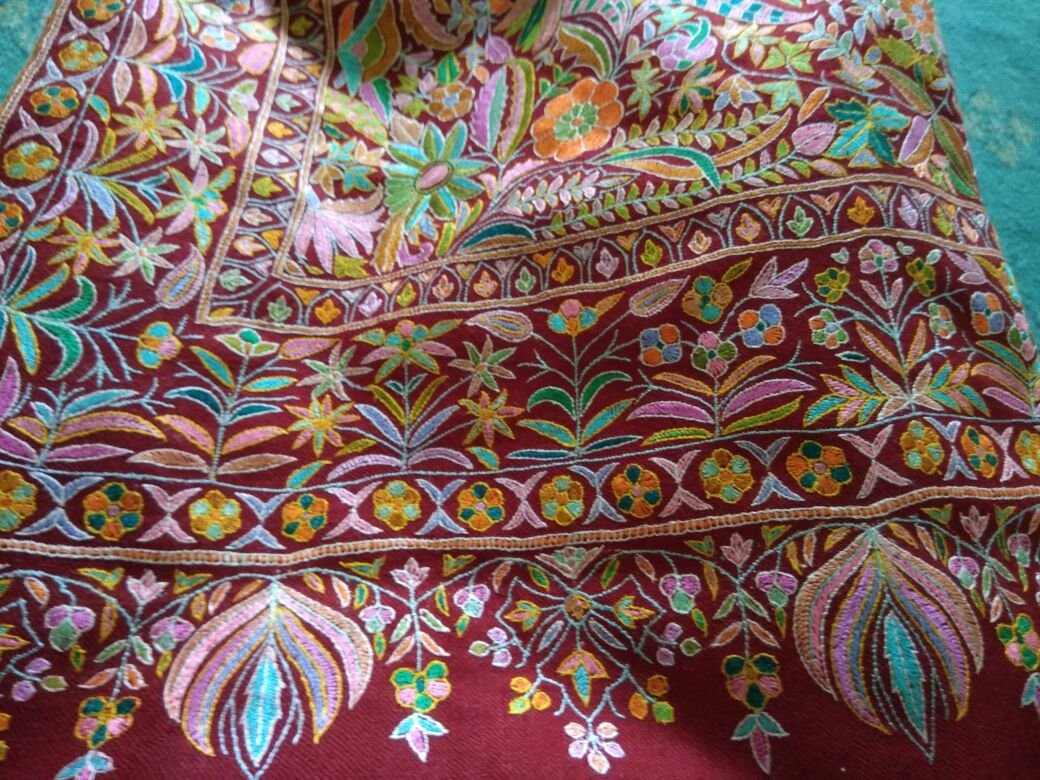
Caveat: Thick, heavily embroidered Pashminas (like Jamawars or Tilla-work shawls) are dense and heavy; they will not pass through a ring. Only ultra-fine, unembroidered or lightly woven ring stoles possess this property. Do not judge a heavy winter shawl by this test alone.
4. Navigating Labels, Certifications, and Common Traps
When shopping online or in retail boutiques, buyers often fall victim to clever marketing terminology.
-
Beware of “100% Cashmere” Blends with Silk: While silk-cashmere blends are luxurious and common, they alter the drape and warmth of the fabric. Insist on pure Pashmina if you want traditional thermal performance.
-
The Geographical Indication (GI) Tag: Authentic Kashmiri Pashminas often carry a GI Certification Mark introduced by the Government of India to protect genuine artisans. This tag verifies that the shawl was spun and woven in Kashmir using authentic Changthangi goat fleece by certified local craftsmen.
-
Price Reality Check: If an online store is selling a “100% Pure Pashmina Shawl” for ₹1,500 ($18 USD), it is mathematically and economically impossible to be genuine. The cost of raw Changthangi wool, combined with weeks of hand-spinning and hand-weaving, ensures that authentic pieces reflect their true artisanal value.
Summary Checklist for Buyers
-
Source Transparency: Does the seller explicitly state the origin of the fiber?
-
Texture Check: Is it warm and matte, or overly slippery and glossy?
-
Weave Irregularities: Can you spot the subtle charm of hand-spun yarn?
-
Reputation: Are you purchasing from trusted D2C artisans and platforms dedicated to preserving Kashmiri heritage?
By demanding authenticity, you protect an endangered craft and secure an heirloom piece that will last across generations.